The wellness world just discovered “neurowellness” — regulating the nervous system as the next frontier of healing. I’ve been practicing exactly that, through a modality most people have never heard of, for 25 years.
The Real Problem
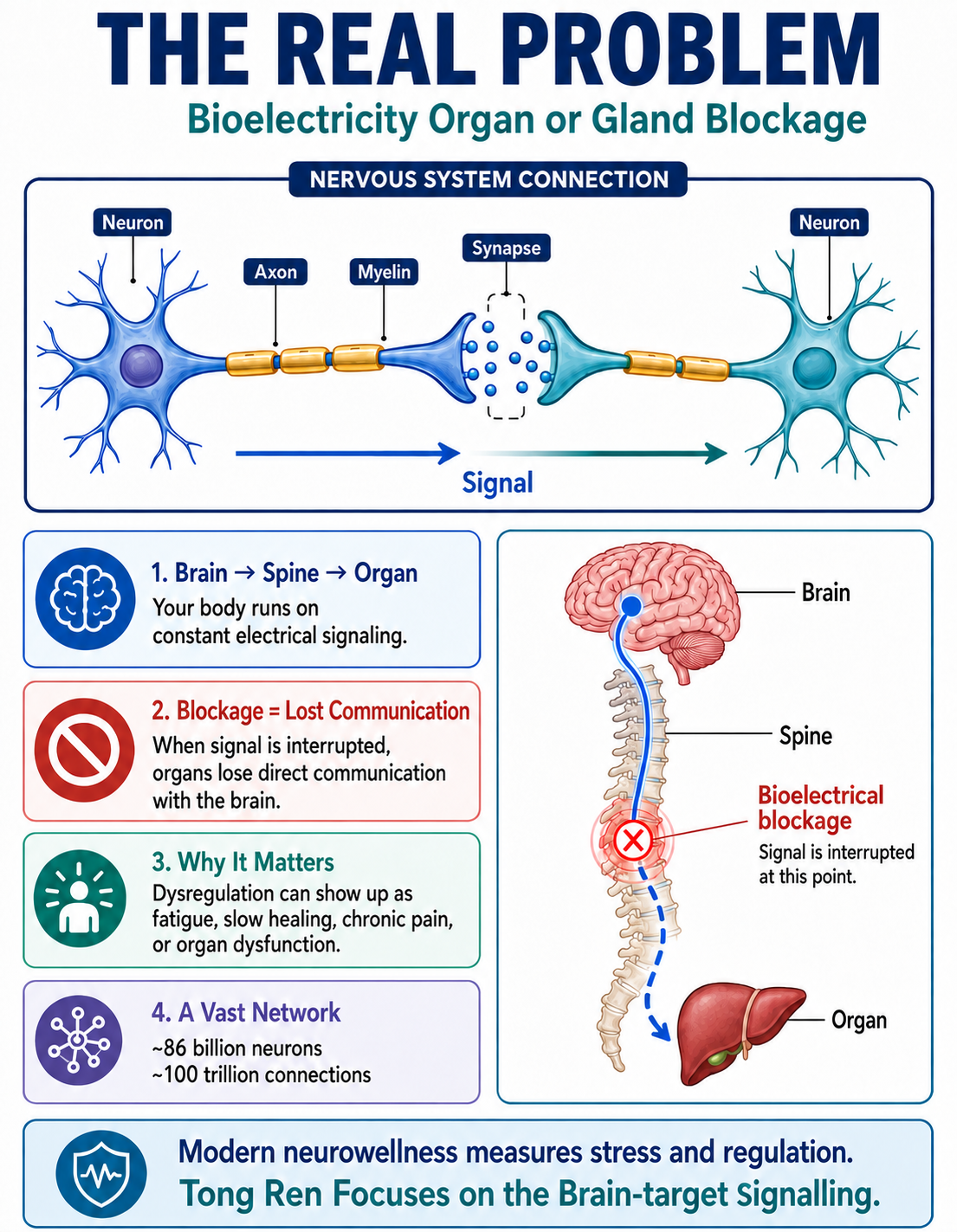
Modern wellness has finally caught up to something ancient healing traditions never doubted: the nervous system is central to almost everything. One of 2026’s biggest wellness trends is what researchers are calling neurowellness — the recognition that chronic stress and nervous system dysregulation sit underneath conditions we usually treat as separate problems, from fatigue to organ dysfunction to slow healing and chronic pain.
The wellness industry’s answer has largely been technological: neurotech wearables, biofeedback devices, apps that measure heart rate variability and tell you how regulated you are. These tools aren’t wrong, but they measure a problem without addressing its root, and they often overlook something simpler and older. The nervous system isn’t just chemical. It’s electrical. And electrical systems can develop blockages, points where signal simply stops getting through. This is where Tong Ren comes in, a practice I’ve spent 25 years learning, refining, and now teaching around the world.
Understanding the Root Cause
Every organ and gland in your body has a direct signaling relationship with your brain, transmitted along the spine. Your brain isn’t just in charge in some abstract sense; it’s in constant electrical conversation with every part of your body, and the spine is the primary transmission line. When that signal gets interrupted, a bioelectrical blockage, the target organ or gland doesn’t just lose vague support. It loses direct communication with the command center.
Modern neuroscience backs up how staggering this network really is. The human brain contains roughly 86 billion neurons, and those neurons form an estimated 100 trillion connections to each other, more connections than there are stars in several galaxies combined. This is not a static wiring system. It’s a living, dynamic electrical network, constantly sending and adjusting signal in real time. Tong Ren works with this network directly. The nervous system doesn’t just react to injury or illness at the site; it reflects it, in mappable ways, along the spine.
Get Your Baseline
Before starting any healing practice, Tong Ren included, get a baseline. Write down how you feel today, and if you can, get a set of baseline bloodwork before starting so you can track your progress. This matters more than most people realize, because most practitioners only look at how someone feels in the moment, with no record of where they started. That’s especially true with Tong Ren, where results build gradually rather than dramatically. Without a baseline, real progress can go unnoticed, and that’s exactly when people give up on something that’s actually working.
The Solution — Opening the Blockage, Restoring the Signal
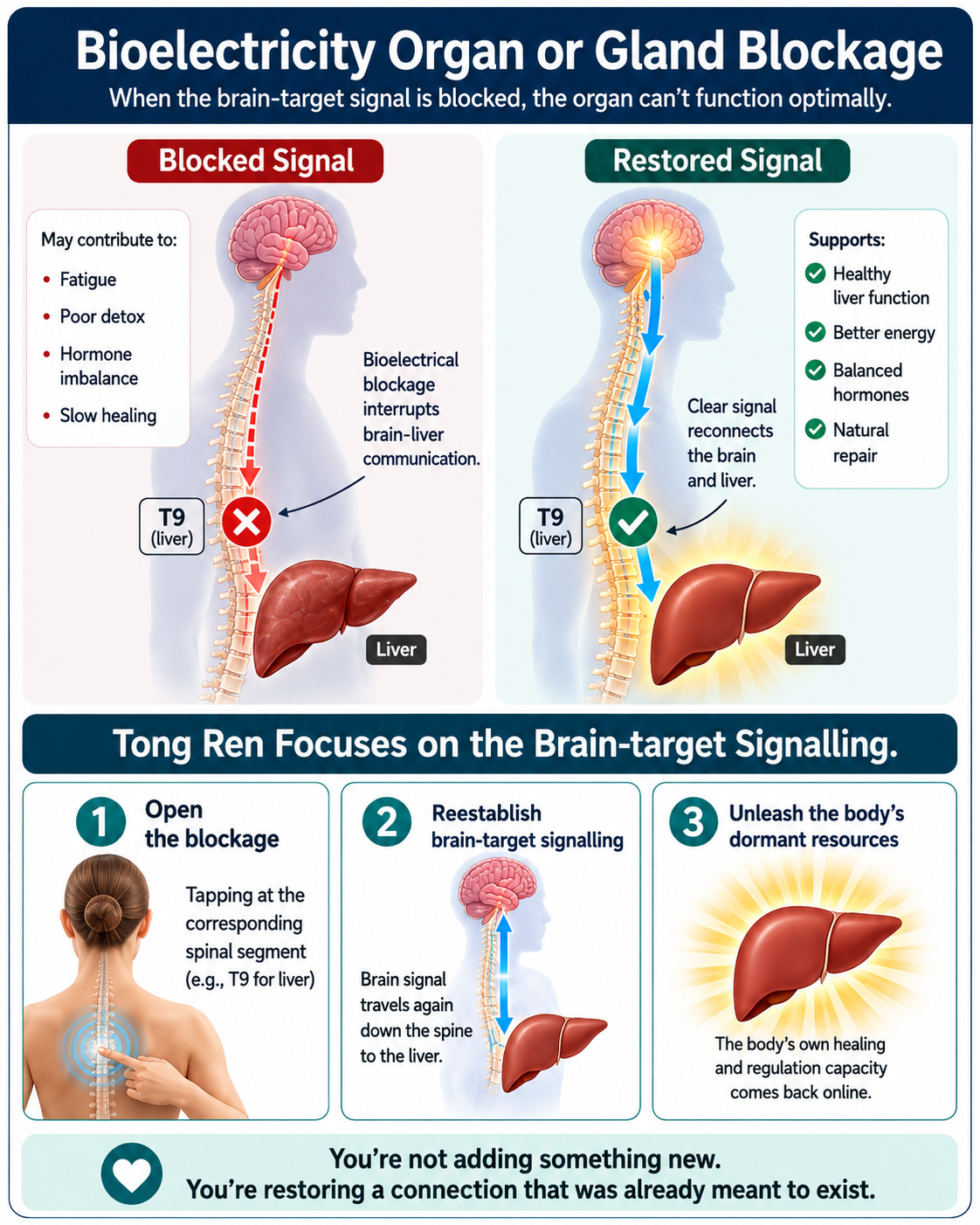
Tong Ren works through a three-step sequence, and understanding this sequence is the key to understanding why it works at all. The first step is opening the blockage. Using tapping techniques directed at specific points, often at the corresponding spinal segment, Tong Ren works to clear the bioelectrical obstruction sitting between the brain and the target organ or gland.
The second step is reestablishing brain-target signaling. Once the blockage is cleared, the brain’s signal can travel again, down the spine, to the organ or gland that had been cut off. This is the piece most healing approaches skip entirely. You’re not adding something foreign to the body. You’re restoring a connection that was already meant to exist.
The third step, and the real goal, is unleashing the body’s dormant resources. The body already carries vast healing capacity; it doesn’t need that capacity delivered from outside. It needs the signal that activates and directs it. Once brain-to-target communication is restored, the body’s own capacity for repair and regulation comes back online.
The spine maps to the body with real specificity. A few examples: T3 corresponds to the lungs, T5 to the heart, and T9 to the liver. When someone has ongoing dysfunction in one of these organs, working at the corresponding spinal level isn’t guesswork. It’s targeting the exact point where signal may be interrupted. This is also why distance healing works the way it does. We aren’t working on tissue directly; we’re working on signal, and signal, unlike touch, isn’t confined by physical proximity.
My Own Path to Tong Ren
I didn’t start out as a healer. I trained as an engineer, and looking back, I think that background is part of why the electrical, signal-based model of Tong Ren made so much sense to me. I wasn’t looking at the body as mystical; I was looking at it as a system, with wiring, transmission points, and blockages. What pulled me away from engineering was a growing desire to be of direct service to people, not designing systems but helping restore them. That led me to Tui Na and to Tong Ren specifically, studying under Tom Tam, the founder of Tong Ren, for the past 25 years. That commitment eventually led me to write the field’s main anatomy reference, a 400-page point location book for Tong Ren and the Tam Healing System. I’ve maintained a personal practice this entire time, and today I teach this work to practitioners around the world. What’s kept me committed isn’t one dramatic case. It’s the consistency of what happens when a blockage clears and signal is restored, again and again, in people who had stopped expecting their bodies to respond to anything.
Benefits
Tong Ren is non-invasive and drug-free, working entirely through bioelectrical signaling with no substances introduced into the body. It addresses root communication rather than just symptoms, working at the level of the signal itself instead of managing the target site alone. It works alongside conventional care rather than replacing it, and because it works through signal rather than proximity, distance is never a barrier to receiving it.
What You Can Start Today
Get your baseline first. Learn the spinal mapping relevant to what you’re working on, whether that’s T3 for the lungs, T5 for the heart, or T9 for the liver. If you’re new to Tong Ren, seek a properly trained practitioner rather than attempting self-treatment on complex conditions. Always consult your doctor before beginning any new health practice. And consider this affirmation: my body’s signal was never broken, only interrupted. I open the pathway, and the body does what it already knows how to do.
“The body isn’t waiting to be healed from the outside. It’s waiting for the signal to come back on.”— Joseph Lucier
Most of what’s sold as “healing tea” today is closer to flavored water than medicine — and the difference between the two could be the difference between a body that recovers and one that stays stuck.
The Real Problem
Walk into any grocery store and you’ll find an entire aisle devoted to “wellness tea” — turmeric ginger, detox blends, immunity boosts, all wrapped in soothing packaging. What most people don’t realize is that the majority of these products are brewed for flavor, not function. The herb content is minimal, often a fraction of a gram per bag, processed and stored in ways that degrade the very compounds that made the plant medicinal in the first place.
This matters more than most people realize, because tea isn’t just a comfort ritual — it’s one of the oldest and most direct delivery systems humans have ever used for plant medicine. When someone is dealing with malnutrition, a lingering infection, the aftermath of cancer treatment, or slow-healing injury, their body isn’t short on comfort. It’s short on specific, bioavailable compounds it needs to rebuild, defend, and repair. A weak, processed tea can’t deliver that. A properly prepared therapeutic tea can.
In the Anusara framework, we look at healing through three root causes: deficiency, toxicity, and chronic inflammation. Malnutrition is a deficiency problem. Infection often involves both deficiency and inflammation. Cancer recovery and injury frequently involve all three at once. Herbal tea, prepared correctly, is one of the most direct tools we have for addressing each of these — but only if you understand it’s medicine, not decoration.
Understanding the Root Cause
Here’s what’s actually happening in the body during these four conditions. Malnutrition isn’t only about calories — it’s about the body lacking the specific micronutrients, minerals, and cofactors it needs to run basic repair processes. Infection puts the immune system under sustained demand, burning through resources faster than a depleted body can replace them. Cancer recovery and injury both require the body to rebuild tissue, manage inflammation, and clear cellular debris — all processes that depend heavily on nutrient and compound availability.
Traditional Chinese medicine has approached this for thousands of years through the lens of matching the remedy to the deficiency — not treating symptoms in isolation, but asking what the body is missing and what’s overwhelming it. Modern science is increasingly validating this same principle: specific plant compounds — polyphenols, alkaloids, mucilage, tannins — have measurable, targeted effects on inflammation, immune response, and tissue repair. The two systems aren’t in conflict. They’re describing the same terrain from different angles.
This is where herbal tea becomes powerful rather than incidental. Different plant categories deliver fundamentally different therapeutic actions, and matching the right category to the right need is the entire game.
Get Your Baseline
Before you start any targeted herbal protocol, get a baseline. Write down how you feel today, and if you can, get a set of baseline bloodwork before starting so you can track your progress. This is important. Most people — and most practitioners — only look at how you’re feeling right now, with no record of where you started. Without that starting point, improvement becomes invisible. You won’t notice the infection resolving more quickly, the energy slowly returning, or the inflammation easing, because you have nothing to compare against.
This is one of the most common reasons people abandon a healing path that is actually working — they can’t see the progress, so they assume there isn’t any. If you’re working with a practitioner, ask for actual lab markers where relevant. Then revisit that baseline in four to six weeks.
The Solution — Targeted Herbal Tea Categories
Not all healing teas serve the same purpose. This is the piece most wellness content skips entirely. Once you understand the major categories, you can start matching the tea to what your body actually needs — instead of drinking the same blend regardless of what’s going on internally.
Adaptogenic teas — Herbs like ashwagandha, holy basil, and eleuthero help the body regulate its stress response and support the adrenal system. Especially valuable during infection recovery and injury healing, when the body is under sustained physiological demand.
Astringent teas — Herbs like raspberry leaf, witch hazel, and yarrow tone tissue, tighten mucous membranes, and help manage excess discharge or inflammation. These play a supportive role in wound healing and certain infection presentations.
Bitters — Herbs like dandelion root, gentian, and burdock root stimulate digestive function — saliva, stomach acid, bile production — supporting nutrient absorption and liver function. This matters enormously for someone dealing with malnutrition: you can consume the right nutrients, but if digestion is weak, the body can’t actually use them.
Demulcents — Herbs like slippery elm, marshmallow root, and licorice root are high in mucilage, soothing and coating irritated or inflamed tissue along the digestive tract and mucous membranes. Notably, slippery elm — one of the four core Essiac herbs — falls into this category, part of why Essiac supports tissue healing so effectively.
Nervine teas — Chamomile, skullcap, and lemon balm calm the nervous system directly. Chronic stress compounds every one of the four conditions we’re discussing, so calming the nervous system isn’t a luxury — it’s part of the treatment.
Anti-inflammatory teas — Turmeric, ginger, and licorice root address the chronic inflammation that underlies cancer progression, slow injury recovery, and prolonged infection. This category deserves special attention because inflammation is one of the three root causes behind nearly all serious disease.
Alterative (blood-purifying) teas — This is where Essiac belongs, and it deserves its own spotlight.
Essiac Tea: A Closer Look
Essiac has one of the most compelling origin stories in herbal medicine. The formula traces back to Ojibwe healing traditions, brought to a Canadian nurse named Rene Caisse in the 1920s, who spent decades using it to support patients facing serious illness, including cancer. The name “Essiac” is simply Caisse spelled backward.
At its core, Essiac builds the immune system and detoxifies the blood and liver — traditionally used alongside the most respected anti-disease and anti-cancer herbs in the herbal tradition. Its four-herb formula supports the body’s own detoxification pathways, helping clear the bloodstream and support liver function, which is foundational to how the body defends against and recovers from serious illness. This is part of why Essiac has held such a lasting place in alterative herbal medicine for a century.
The traditional formula centers on four herbs: burdock root, sheep sorrel, slippery elm bark, and turkey rhubarb root. What makes Essiac significant isn’t just the herb list — it’s the preparation. This isn’t a quick steep-and-drink tea. Traditional Essiac preparation involves simmering the root and bark components for an extended period, then letting the full mixture steep for hours, sometimes overnight, to properly draw out the medicinal compounds locked inside dense plant material. This is fundamentally different from dropping a tea bag into hot water for three minutes.
This brings us to the piece almost nobody talks about: how you brew matters as much as what you brew.
Steeping Barks and Twigs for Bioavailability
Delicate leaves like chamomile or lemon balm release their compounds quickly — a five-minute steep is often enough. Barks, roots, and twigs are an entirely different matter. Their medicinal compounds are locked inside dense, woody cell structures that a quick steep simply cannot break down.
This is why traditional preparation calls for a decoction rather than a simple infusion — simmering the bark or root material in water, often for 20 to 45 minutes, sometimes longer for tougher material like slippery elm bark or turkey rhubarb root. This extended heat and contact time breaks down the cellulose structure and pulls the medicinal compounds into the water where your body can actually absorb them.
Skip this step, and you’re left with tea-flavored water — the plant material was present, but the medicine never made it into your cup. This is the single biggest gap between “drinking herbal tea” and “practicing herbal medicine.”
Why Herbal Tea Over Conventional Medication
Properly prepared herbal teas offer something most pharmaceutical interventions can’t: whole-plant synergy. A single herb contains dozens of compounds working together, which is part of why traditional herbal medicine so often comes with minimal to no side effects, compared to isolated synthetic compounds that target one pathway aggressively and frequently disrupt others. This doesn’t mean herbal tea replaces medical care when it’s needed — it means it offers your body a gentler, more collaborative path toward healing, working with your physiology instead of overriding it.
Benefits
Fewer to no side effects. Because whole-plant compounds work synergistically rather than as a single isolated agent, properly prepared herbal teas tend to be far gentler on the body than pharmaceutical alternatives.
Targeted, root-cause support. Matching the right tea category to your specific need — adaptogenic, astringent, bitters, demulcent, nervine, or anti-inflammatory — means you’re addressing what’s actually happening in your body, not masking a symptom.
Deeper nutrient and compound absorption. Proper decoction of barks and roots delivers compounds a quick steep never reaches, meaning you get real therapeutic value instead of flavored water.
A sustainable, lifestyle medicine and daily healing practice for long-term success, not just short-term gains. Unlike short-term interventions, herbal tea can become a daily ritual that supports the body continuously — building over weeks and months rather than working against the body in a single aggressive dose.
What You Can Start Today
Start with one tea, prepared correctly. Pick the category that matches what your body needs most right now — adaptogenic if you’re under sustained stress or recovering from infection, anti-inflammatory if inflammation is your primary concern, bitters if digestion and nutrient absorption are the issue, or alterative if you’re drawn to something like Essiac.
Buy organic, whole-herb material from a trusted source — not a processed tea bag from a grocery shelf. Look for original, traditional formulas rather than modern reformulations that cut corners on both herb quality and ratio. If you’re preparing bark or root, commit to the full decoction process — don’t shortcut the simmer time.
Important: Always consult your doctor before adding new herbs or practices, especially if you’re managing an active illness, undergoing treatment, or taking medications that could interact with herbal compounds.
Affirmation:“My body knows how to heal. I give it what it needs, and I trust the process, one cup at a time.”
“Healing was never meant to be complicated — it was meant to be intentional. When you understand what you’re actually drinking, tea stops being a habit and becomes medicine again.”— Joseph Lucier
The reason most people never heal has nothing to do with finding the right remedy. It has everything to do with what happens between the moment you decide to heal and the moment you give up.
The Uncomfortable Truth About Why You’re Still Stuck
You’ve tried things. Maybe many things. And some of them probably would have worked — if you had stayed with them long enough.
The real crisis in natural healing isn’t a lack of information or even a lack of good remedies. It’s a pattern that shows up over and over: people buy the supplement, start the protocol, feel a small shift, and then stop. Life gets busy. Someone in their family questions what they’re doing. Progress feels too slow. And they move on to the next thing, carrying the quiet belief that maybe healing just isn’t for them.
That belief is the real disease.
There are three root reasons healing fails — and none of them are the ones most practitioners talk about.
The first is not following through. People purchase things they never use and follow instructions for three days instead of three months. Healing is not a transaction. It’s a practice.
The second is quitting too soon. The body heals in layers, and progress is rarely linear. Most people give up right before the shift comes — not because the approach wasn’t working, but because they had no system to keep going when motivation faded.
The third — and the hardest to talk about — is not believing you are worth healing. This one sits underneath almost everything else. It shows up as deprioritizing your own care, dismissing your symptoms, or quietly deciding that full health is for other people.
What’s Actually Making You Sick
Before you can build a healing system that works, you need to understand what you’re actually healing. At the Anusara Path, every condition — from low energy to chronic disease — is understood through three root causes.
Deficiency is a lack of what the body needs to function: oxygen, essential nutrients, minerals. Modern diets and modern stress create chronic deficiency even in people who think they eat well.
Toxicity is the accumulation of what the body cannot eliminate: heavy metals, environmental chemicals, processed food byproducts. The body doesn’t malfunction randomly — it responds to its environment.
Chronic inflammation is what happens when deficiency and toxicity go unaddressed long enough. It is not a condition itself — it is the body’s sustained alarm signal. And it is now understood to be the underlying driver of most serious diseases, including cancer.
The reason most approaches fail is that they address the symptom — the alarm — without ever turning off what triggered it.
Get Your Baseline Before You Do Anything Else
One of the most overlooked steps in any healing journey is establishing a baseline. Before you change anything, get your numbers — bloodwork, key markers, whatever is relevant to your condition.
Here’s why this matters: many practitioners only look at where you are today. Without a starting point, improvements become invisible. You feel better but can’t prove it to yourself or anyone else. That lack of visible progress is one of the most common reasons people abandon a healing path that is actually working.
Track your baseline. Return to it regularly. Let the data tell the story your body is living.
The Integration Method That Actually Works
Healing doesn’t fail because people lack willpower. It fails because people try to heal alone, without a system, in an environment that wasn’t designed to support them.
The integration method is about building the conditions for healing — not just the protocol.
Start with a morning routine you can actually keep. Not an aspirational two-hour wellness ritual. One or two anchoring practices that signal to your body and mind that healing is happening today. Daily sun gazing. An affirmation. A few minutes of movement. Consistency matters infinitely more than intensity.
Set goals around steps, not outcomes. Instead of “I want to lose twenty pounds,” choose “I will walk twice this week.” Reward yourself for doing the thing — not for achieving the result. This rewires your relationship with progress and keeps you in the practice long enough for real change to happen.
Choose one doable exercise and commit to it once or twice a week. That’s it. Don’t overcommit. The goal is to build a relationship with movement, not to exhaust yourself into quitting.
Before starting any new practice or supplement, consult your doctor to check for conflicts with any current medications. This is not optional — it is the foundation of safe, integrated healing.
Build Your Healing Support System
Healing in isolation is one of the hardest things a person can do. The integration method requires people — the right people.
Tell your family what you are doing and why. You don’t need their permission, but you do need to reduce the friction of secrecy. When people close to you don’t know what you’re trying, they can unintentionally undermine it.
Find one person — a coach, a practitioner, a trusted friend — who you can communicate with as you put new things into practice. Not someone who will cheer for you blindly, but someone who will help you stay honest and stay in it.
One of the most underestimated obstacles in natural healing is the pressure from people who want you to take a traditional approach. Family members get frightened. Friends become skeptical. This is real, and it deserves a real response. The answer is not to argue — it is to educate yourself deeply enough that you can stand in your own knowing. Study the science behind what you’re doing. Understand the mechanisms. When you can speak to the research, fear — yours and theirs — loses its grip.
What You Can Start Today
You don’t need a perfect plan. You need a first step.
Get your baseline. Ask your doctor for a full panel and keep a copy for yourself.
Pick one morning practice and do it every day for two weeks before adding anything else.
Choose one person to tell about your healing intentions — someone who will support, not discourage.
Do a simple self-assessment: Where do you feel the most depletion? Where does your body feel burdened or inflamed? Your answers point toward whether deficiency, toxicity, or inflammation is your primary imbalance — and where to focus first.
Affirm it.“I am worth healing. My body knows how to heal. I am building the conditions for that healing every day.”
“Healing is not an event. It is a practice — and like all practices, it requires a system, a community, and the radical belief that you are worth the effort.” — Joseph Lucier
1. Essiac Tea History – Native Wisdom for a Modern Remedy
The Ojibwa (also spelled Ojibwe or Chippewa) are one of the largest Indigenous nations in North America, part of the Anishinaabe people, with traditional territories spanning the Great Lakes region of Canada and the northern United States. Known for their rich oral traditions, herbal medicine, and deep relationship with the land, the Ojibwa have long practiced plant-based healing rooted in spiritual and ecological knowledge passed down through generations.
In the 1920s, Nurse Rene Caisse, a Canadian nurse, learned of an herbal remedy from a patient who claimed an Ojibwa healer had used it to treat her breast cancer. Caisse later refined and administered this formula, naming it Essiac Tea (her surname spelled backwards), and used it at her Bracebridge, Ontario, clinic to help patients with cancer and other illnesses.
In later years, Dr. Charles A. Brusch, who served as a personal physician to President John F. Kennedy and directed the Brusch Medical Center in Massachusetts, became a key figure in the further development of Essiac. Working directly with Nurse Caisse in the 1950s and 60s, Dr. Brusch conducted research on the formula at Harvard, and eventually expanded it from the original four-herb blend to an eight-herb formula, aiming to enhance its therapeutic effects and broaden its healing scope.
The formula became the advanced 8-herb formula I use in my practice. They are very sincere and honorable people with a simple mission of reducing suffering and offering a 100% refund if not satisfied. After many years of reviewing many formulas, I only chose this one, especially since the supplier I use was also connected to the Harvard Review and sticks to the original formulation and preparation.
2. Understanding Cancer
Cancer is caused by a lack of oxygen, hypoxia. This was proven multiple times by the Nobel Prize-winning scientist, Dr. Otto Warburg. When there is a survival challenge in the body, the normal cellular respiration and energy production can not function, and the body resorts to an inferior form of cellular respiration and energy production until the unhealthy conditions are resolved. In the image, you can see that cancer cells produce less energy overall, but enough to keep us alive until we solve the problem.
Anything that interferes with our oxygen availability can increase the inner body condition, enabling cancer, such as the following. An inner terrain of acidity and toxicity can cause cancer.
Poor diet
Inflammation
Toxicity
Nutrient deficiency
Essiac, along with simple dietary changes, works on toxicity, inflammation, and even nutrient deficiency, and above all, acts as a blood cleanser and supports the detoxification of the liver. When we have these challenges, there is less oxygen available, and the conditions for cancer can increase.
3. Essiac Tea Benefits
Antioxidant Activity – Essiac tea exhibits strong free radical scavenging capacity – Studies have shown that Essiac tea contains polyphenols and tannins that reduce oxidative stress by neutralizing free radicals, which may help prevent cellular damage.
Anti-inflammatory Effects – Reduces markers of inflammation in vitroEssiac tea has been shown to inhibit key inflammatory mediators such as nitric oxide and prostaglandins in laboratory models, indicating potential for chronic inflammation management.
Immune System Modulation – Enhances phagocytosis and lymphocyte activity – Certain studies suggest Essiac tea can stimulate components of the innate immune response, improving macrophage activity and possibly enhancing immune surveillance.
Cytotoxic Effects Against Cancer Cell Lines – Demonstrates selective inhibition of tumor growth in vitro – Research has found that Essiac tea extracts reduce proliferation of human prostate and ovarian cancer cells in a dose-dependent manner, though results are limited to cell cultures.
DNA Protection from Oxidative Damage – Shown to protect against DNA strand breaks – In controlled experiments, Essiac tea reduced DNA damage caused by hydrogen peroxide, suggesting a role in genomic stability under oxidative stress. In vitro studies show that Essiac effectively neutralizes hydroxyl and superoxide radicals—reducing them by up to 84%—and protects DNA and lipids from oxidative damage
The recipe should be done exactly as it is in the instructions (anusarawellness.com/essiac), and according to your current condition.
Serious need – 3 ounces 3 times a day. Spreading it out is also a healing strategy, as is often done with herbs, to keep a constant push on the body to get the effect without long gaps
Medium need – 2 ounces 3 times a day. For people in remission
Maintenance – 2 ounces twice a day for ongoing maintenance and support
Remember, the critical recommendation for the best results, is consistency and purity. The blend I recommend, as an herbalist, is pure, advanced, and effective.
5. Conclusion
The tea is affordable, so people can use it long-term, and many case studies and data show that it is beneficial right away and has its strongest impact after about 5.5 to 6 months of consistent usage.
In simple terms, clay is mud. In more elegant terms, earthen clay is one of nature’s quiet miracles—soft, fine-grained soil created through the ancient, patient work of time and the elements. It begins with the breakdown of rocks—both igneous and metamorphic types—under the influence of wind, water, and natural forces such as freezing and thawing.
As these rocks crumble, rainwater and slight acidity in the environment slowly dissolve their minerals. This process, called weathering, transforms solid stone into ultrafine mineral particles.
Once formed, these tiny clay particles don’t just stay put. Carried by rivers and streams, they eventually settle in calm environments such as lakebeds, river deltas, or shallow seas. There, they begin to accumulate in layers—a process called sedimentation.
Over the centuries, these layers compact under their own weight, gradually forming thick beds of clay. As they settle, clays absorb surrounding minerals, giving each variety its own unique composition and healing properties.
The result of this long journey is a rich palette of healing clays, each with special characteristics. Bentonite clay, for example, forms from volcanic ash and is highly absorbent—perfect for drawing toxins from the skin. Kaolin clay, soft and white, is commonly used in gentle facial masks and even in some medicines.
French green clay, packed with iron and marine minerals, has a striking color and is popular in spa treatments. And Rhassoul clay from Morocco, rich in magnesium, has been prized for centuries for its benefits to both skin and hair care. All of these clays are gifts of Earth’s slow alchemy—mineral intelligence shaped over millions of years.
The most effective minerals for nutrient assimilation, detoxification, skin repair (due to clay’s silica content formed into collagen), and numerous other observed health benefits will be derived from a true phyllosilicate [Silica-based] clay created by Nature’s own manufacturing process.
The smaller the particle size, the more surface area becomes available for bonding with metals, chemicals, pathogens, etc.
Sacred Clay (VitalityHerbsAndClay.com – The Only Clay I recommend) contains, from a single deposit, a naturally occurring spectrum of the most widely used types of clay for human, animal, and even garden purposes. It also possesses a percentage of exceptionally small particle size below 0.2 microns.
This may well explain why it works so well in so many areas, with a special level of effectiveness in the detoxification/chelation of undesirables in the body!
Clay for Detoxing
Our community and Anusara Wellness is are big fans of clay for detoxing. We use it exclusively in our 14-day clay detox program.
Here are 5 good reasons clay should be a regular routine in our daily lives:
It binds to heavy metals and escorts them out of the body
It alkalizes the body in order to increase oxygen, decrease inflammation, and prevent disease and cancer.
It is beneficial for bones , as it contains silica, the building block for collagen, which serves as the foundation for all tissues and bones in the body.
It is helpful to remove mold and mycotoxins from the body.
It disables viruses and bacteria in the body.
The sheet-like structure of clay minerals is composed of layers of silica and alumina (or magnesium) bonded with oxygen in the shape of tetrahedrons and octahedrons. (VitalityHerbsAndClay)
Clay Structure
Ways to use Earthen Clay for Health and Healing
Clay baths – Add it to your hot bath. The open pores will more easily absorb the clay and mineralize, alkalize, and nutrify the body, too, as well as bind to toxins. Clay baths are the first option when considering clay for healing.
Clay Foot Soaks – This is also an excellent method. Add the equivalent of 1/2 the bathtub dose to a nice basin of hot water. Not too hot to burn, of course. Then, while you are there, rub the clay water onto your shins, face, arms, and legs.
Clay Poultice – This involves using less water and more clay to create a paste. Then apply the paste to an injury. Cover with a bandage, then leave it on overnight.
Clay Bath Packet
My Story – Fractured Upper Humerus Arm Bone
I had a serious injury and crashed down onto my right shoulder. Instead of surgery, I did acupuncture, Chinese Medicine Orthopedics, and poultices. I used comfrey, the bone-knitting herb, and also used clay poultices to remineralize and regenerate the broken bones. Instead of surgery and a 4-6 month recovery, I was back to work as a bodyworker, within 6 weeks.
Conclusion about Healing Earth Clay
The bottom line is, there are no better binders for detoxification and escorting heavy metals out of the body. Additionally, clay is also a bone-builder, mineralizer, and alkalizer for the body,often the first option when considering clay for its healing properties which makes it an excellent prevantative of disease and cancer.
Rebounding is bouncing up and down. Rebounding involves using your own personal mini-trampoline, where you bounce up and down on a flexible platform. That’s about it, but it is profoundly healing. The lymph system is a body-wide garbage collection system. Without it, we would accumulate garbage and be like a large garbage dump in our bodies.
The Lymph System
Think of it like the plumbing we have in our houses. We have our very own body plumbing to remove toxins from the body and fight disease. The lymph system serves as part of our immune system, too, to eliminate pathogens and waste materials from the body. The liquid itself is part of the immune system, filled with water and immune cells.
Here are the main features:
Blood vessels produce and collect waste and send it to the parallel lymph vessels running next to them throughout the body
Lymph vessels carry waste products from the vessels and the body to the lymph nodes.
Lymph nodes are collection centers located throughout the body in specific regions.
There are four main collection centers: the armpits and the groin.
From there, they all go to the lymphatic duct.
Then to the sub-clavian artery around the shoulders, and then to the blood vessels closer to the detox organs
Then they are managed and excreted by the liver, kidneys, and the colon
Lymph Drainage – A Deeper Look
This lymph system does not have a pump like the heart; it is passive. Most lymph is moved by minimal pressure from the moving flow of blood in the body, and then mostly from the movement of the muscles through exercise or walking.
It’s great to give it a push on a regular basis, especially if we’re not moving or exercising much, and the waste materials become stagnant in the body. This is where the rebounder comes in. Bouncing gently up and down is excellent for activating the lymphatic valves and promoting lymphatic drainage.
Valves managing the lymph drainage are one-directional. Rebounding opens and closes these valves and accelerates waste removal and gives a good workout for the valves too.
Cancer Benefits
We need to detox the body, without a doubt. Rebounding accelerates this detoxification process and increases oxygenation of the body simultaneously. It has been shown to be excellent for cancer patients since detoxification improves their recovery time too, and they get stronger more quickly.
At a core level, this is how it works:
Cancer is an oxygen deficiency that triggers cancer growth.
Toxins take up space normally available for oxygen in the body and cells, and the toxins clog and damage cells
Removing toxins allows more oxygen into the cell.
Bouncing and exercising also increases oxygen in the body
Bones Benefits
It is also excellent for bone building too, as it causes some resistance and pressure. The pressure alone causes bones to get stronger. There is also a force, the piezoelectric force, that activates bone-building, too. The bones respond by getting stronger in response to the stimulus of the stressor, just like building muscle by exercise.
Quantum Biology Lens
A quantum lifestyle and the Quantum Biology lens explain how the body’s functions are interconnected with the universe. Not only does rebounding help us clean out the body, remove toxins, kill pathogens, and build bones, but a quantum lifestyle can also support it.
Personally, I do my rebounding while practicing my sunrise sun-gazing at the same time.
These are some reasons why this can be particularly beneficial and help more, especially for disease recovery and overall health.
Quantum Benefits
Sun-gazing resets the entire endocrine system.
Sun-gazing supports improved bioelectricity and nerve function.
Our bodies are composed of approximately 70% water, and the fluid in our lymph vessels is predominantly water.
Light from the sun on the body transforms bulk water to EZ water, also known as the 4th phase of water, or exclusion zone (EZ) water.
EZ water has more charge, or power, than regular water, also known as bulk water.
The more light it gets from the sun, the stronger the charge.
Quantum and Lymph Drainage Benefits
Since the lymph vessels are primarily composed of water, sunlight will improve their charge and enhance lymph flow.
Science has shown that EZ water improves blood vessel flow, and it thereby also enhances lymphatic flow.
Two EZ water flowing vessels, lymph and blood, with more charge, will also support each other more.
Take Action – General instructions for Rebounding Daily
5-15 minutes twice a day
Start off without even getting air-bound, and do gentle walking.
Hold a bar if you feel unstable. I use a bar on my rebounder. The bouncing also helps with balance, as it fine-tunes the balance mechanisms of the ears and the soles of your feet to improve balance.
Increase to 30 minutes twice a day.
Listen to music while doing it, to make it more fun.
Take breaks when necessary.
Conclusion
Rebounding is a win-win-win opportunity that improves overall health, prevents disease through detoxification, builds bones, and enhances overall circulation. Our bodies function better and heal more effectively when we eliminate waste and take out the garbage.
If you also have the luxury of doing it outside, even better, or even at sunrise as I do, which is not always easy. I live in the northeast, and in the winter, I open a window to see the sun while rebounding.
This is a simple, easy, profoundly healing exercise you can do in the comfort of your own home. You will see, as I have, that rebounders are in all cancer wellness centers around the world. If you are not able to stand or in a wheelchair, simply put your feet on the rebounder and have someone else bounce for you.
Recommended Videos
Here are some good videos below, too. You don’t really have to bounce high at all, and if you feel more comfortable, you can get a rebounder with a bar to hold on to, like I have.