

Tong Ren for the Nervous System: Distance Healing Meets the Neurowellness Movement
The wellness world just discovered “neurowellness” — regulating the nervous system as the next frontier of healing. I’ve been practicing exactly that, through a modality most people have never heard of, for 25 years.
The Real Problem
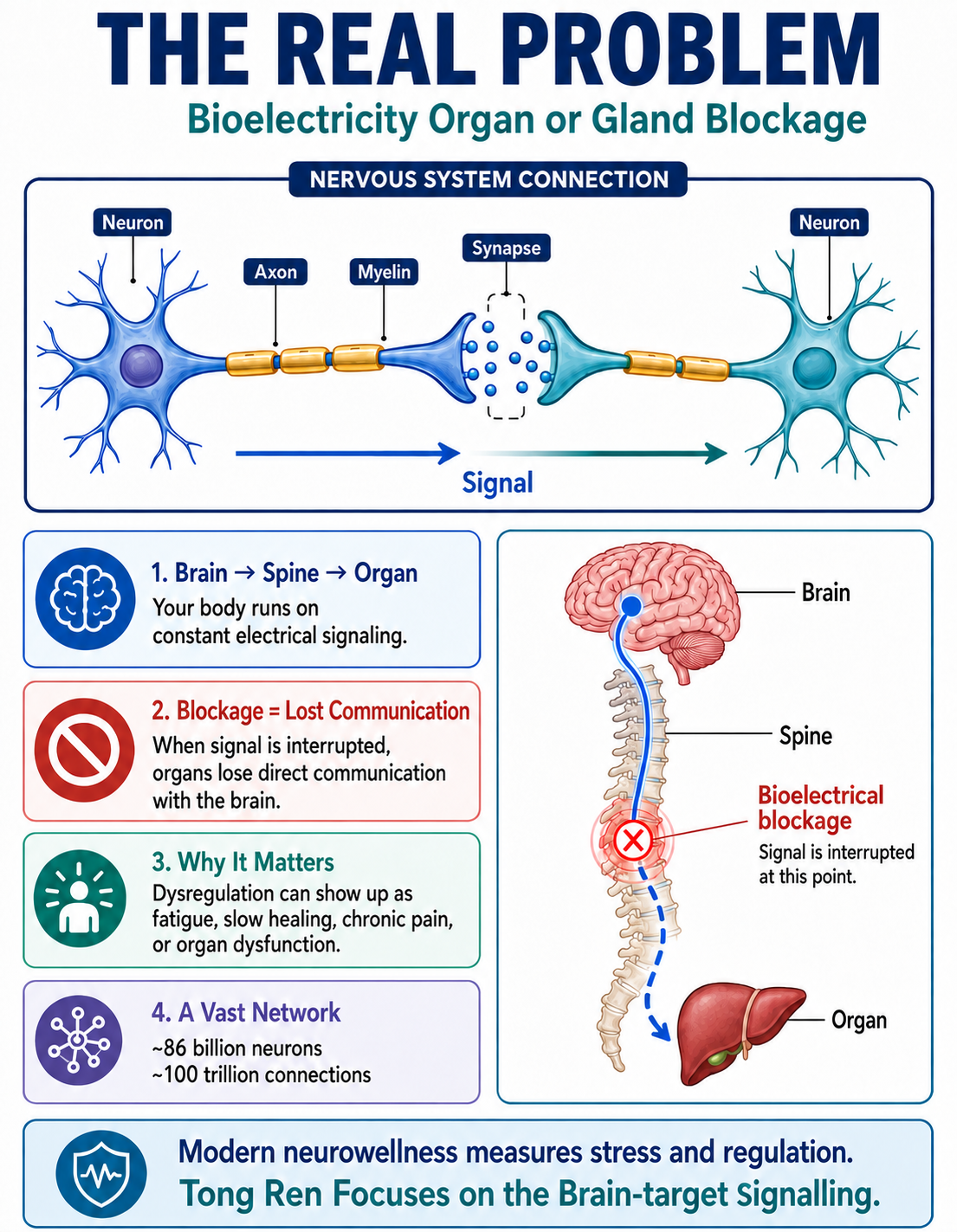
Modern wellness has finally caught up to something ancient healing traditions never doubted: the nervous system is central to almost everything. One of 2026’s biggest wellness trends is what researchers are calling neurowellness — the recognition that chronic stress and nervous system dysregulation sit underneath conditions we usually treat as separate problems, from fatigue to organ dysfunction to slow healing and chronic pain.
The wellness industry’s answer has largely been technological: neurotech wearables, biofeedback devices, apps that measure heart rate variability and tell you how regulated you are. These tools aren’t wrong, but they measure a problem without addressing its root, and they often overlook something simpler and older. The nervous system isn’t just chemical. It’s electrical. And electrical systems can develop blockages, points where signal simply stops getting through. This is where Tong Ren comes in, a practice I’ve spent 25 years learning, refining, and now teaching around the world.
Understanding the Root Cause
Every organ and gland in your body has a direct signaling relationship with your brain, transmitted along the spine. Your brain isn’t just in charge in some abstract sense; it’s in constant electrical conversation with every part of your body, and the spine is the primary transmission line. When that signal gets interrupted, a bioelectrical blockage, the target organ or gland doesn’t just lose vague support. It loses direct communication with the command center.
Modern neuroscience backs up how staggering this network really is. The human brain contains roughly 86 billion neurons, and those neurons form an estimated 100 trillion connections to each other, more connections than there are stars in several galaxies combined. This is not a static wiring system. It’s a living, dynamic electrical network, constantly sending and adjusting signal in real time. Tong Ren works with this network directly. The nervous system doesn’t just react to injury or illness at the site; it reflects it, in mappable ways, along the spine.
Get Your Baseline
Before starting any healing practice, Tong Ren included, get a baseline. Write down how you feel today, and if you can, get a set of baseline bloodwork before starting so you can track your progress. This matters more than most people realize, because most practitioners only look at how someone feels in the moment, with no record of where they started. That’s especially true with Tong Ren, where results build gradually rather than dramatically. Without a baseline, real progress can go unnoticed, and that’s exactly when people give up on something that’s actually working.
The Solution — Opening the Blockage, Restoring the Signal
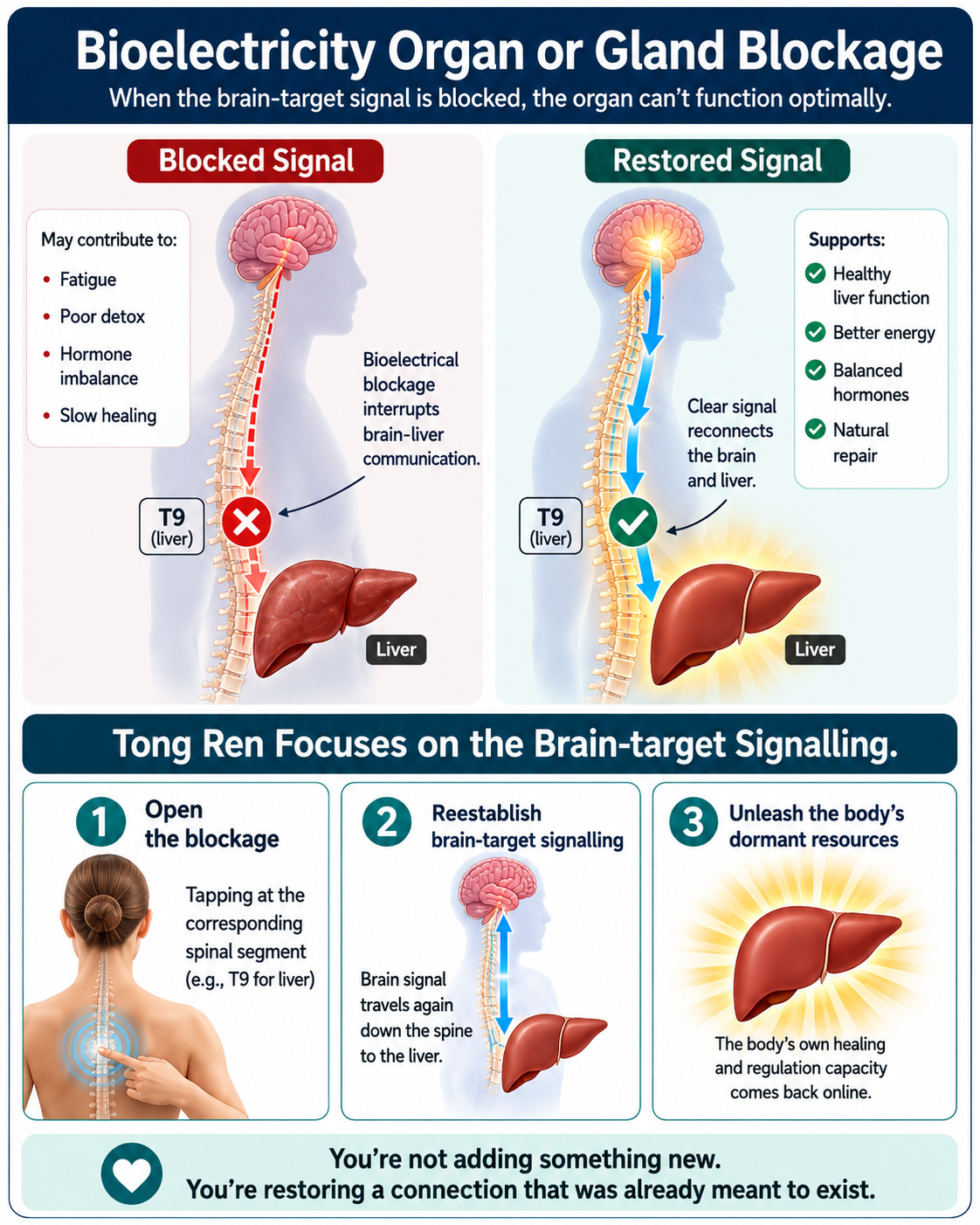
Tong Ren works through a three-step sequence, and understanding this sequence is the key to understanding why it works at all. The first step is opening the blockage. Using tapping techniques directed at specific points, often at the corresponding spinal segment, Tong Ren works to clear the bioelectrical obstruction sitting between the brain and the target organ or gland.
The second step is reestablishing brain-target signaling. Once the blockage is cleared, the brain’s signal can travel again, down the spine, to the organ or gland that had been cut off. This is the piece most healing approaches skip entirely. You’re not adding something foreign to the body. You’re restoring a connection that was already meant to exist.
The third step, and the real goal, is unleashing the body’s dormant resources. The body already carries vast healing capacity; it doesn’t need that capacity delivered from outside. It needs the signal that activates and directs it. Once brain-to-target communication is restored, the body’s own capacity for repair and regulation comes back online.
The spine maps to the body with real specificity. A few examples: T3 corresponds to the lungs, T5 to the heart, and T9 to the liver. When someone has ongoing dysfunction in one of these organs, working at the corresponding spinal level isn’t guesswork. It’s targeting the exact point where signal may be interrupted. This is also why distance healing works the way it does. We aren’t working on tissue directly; we’re working on signal, and signal, unlike touch, isn’t confined by physical proximity.
My Own Path to Tong Ren
I didn’t start out as a healer. I trained as an engineer, and looking back, I think that background is part of why the electrical, signal-based model of Tong Ren made so much sense to me. I wasn’t looking at the body as mystical; I was looking at it as a system, with wiring, transmission points, and blockages. What pulled me away from engineering was a growing desire to be of direct service to people, not designing systems but helping restore them. That led me to Tui Na and to Tong Ren specifically, studying under Tom Tam, the founder of Tong Ren, for the past 25 years. That commitment eventually led me to write the field’s main anatomy reference, a 400-page point location book for Tong Ren and the Tam Healing System. I’ve maintained a personal practice this entire time, and today I teach this work to practitioners around the world. What’s kept me committed isn’t one dramatic case. It’s the consistency of what happens when a blockage clears and signal is restored, again and again, in people who had stopped expecting their bodies to respond to anything.
Benefits
Tong Ren is non-invasive and drug-free, working entirely through bioelectrical signaling with no substances introduced into the body. It addresses root communication rather than just symptoms, working at the level of the signal itself instead of managing the target site alone. It works alongside conventional care rather than replacing it, and because it works through signal rather than proximity, distance is never a barrier to receiving it.
What You Can Start Today
Get your baseline first. Learn the spinal mapping relevant to what you’re working on, whether that’s T3 for the lungs, T5 for the heart, or T9 for the liver. If you’re new to Tong Ren, seek a properly trained practitioner rather than attempting self-treatment on complex conditions. Always consult your doctor before beginning any new health practice. And consider this affirmation: my body’s signal was never broken, only interrupted. I open the pathway, and the body does what it already knows how to do.
“The body isn’t waiting to be healed from the outside. It’s waiting for the signal to come back on.”— Joseph Lucier


